
Calling all birdwatchers! We need your help to find out where the Curlews ringed through Curlew LIFE spend the winter.
If you’re out around the coasts at this time of year, please keep your binoculars and telescopes peeled for ‘our’ birds, or indeed any ringed Curlews.
Although our project focused on improving conditions for Curlews on their breeding grounds at our five project areas, it’s hugely valuable for us to know where they overwinter.
It all adds to the growing body of knowledge about these struggling birds, which conservationists can draw on to help them.
If you see any ringed birds, please make a note of:
- Colour of rings or flags
- Which leg each one is on
- Where on the leg (above or below the ‘knee’)
- Any lettering you can read
- Date
- Location
Ideally, get a photo of the bird if you can, but records without photos are still valuable.
Then, please email the details (and photo if you have one) to: stephen.dodd@rspb.org.uk.
Ring combinations used at Curlew LIFE sites
Our ring combination is:
- Orange flag on left tibia (above ‘knee’)
- Green ring on right tibia (above ‘knee’)
- Metal ring on right tarsus (below ‘knee’)
Look out for lettering on the orange flag. Most sites have used two letters, except at RSPB Geltsdale, where we used 3 numbers.
-
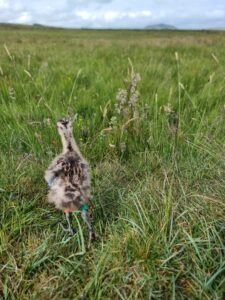
- © RSPB Katie Gibb
-
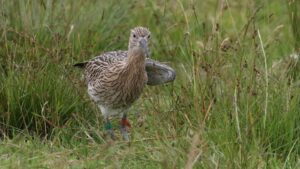
- © RSPB Neal Warnock
-
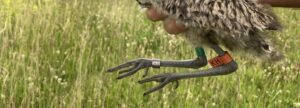
- © RSPB Alex Starace
Spotted a Curlew with a different ring combination?
Stephen is also happy to help trace where other colour-ringed Curlew were originally ringed, so do get in touch with him if you spot Curlews with any ring combinations.
Sightings of Curlew LIFE birds
There have been a few winter sightings of our ringed Curlews. One was a female adult ringed at RSPB Insh Marshes, who overwintered on the west coast of Ireland and returned to the nature reserve to breed again in 2024. Read more about her travels >
There was a sighting of a Curlew on the Calf of Man (Isle of Man) in September 2024 with a ring/flag combination that matched ours. Unfortunately, it wasn’t possible to read the lettering. BTO and WWT have also used a small number of these flags, so we can’t be sure it was a Curlew LIFE bird.
Our team at Ysbyty Ifan & Hiraethog have spotted a Curlew breeding there that was ringed as part of a GPS tracking project by the British Trust for Ornithology in 2019. This female with ring number FJ23427 has been seen at our site each year, and resighted several times at the River Axe (Lyme Bay in Devon) outside the breeding season.
Shedding light on site
Ringing isn’t just about winter sightings, though. It’s already given us some fascinating insights into how Curlews use our project areas. Perhaps the most intriguing of all was a case of adoption at our Antrim Plateau site. Read about how chick LH found a new family >
Take part in winter bird counts
It’s always valuable to record your sightings of waders on recognised systems such as BirdTrack or eBird, but there are also coordinated counts that you can take part in.
Wetland Bird Survey (WeBS) – Monitors non-breeding waterbirds including waders at specific sites throughout the year. Run by the British Trust for Ornithology (BTO).
Wader Conservation World Watch – Happens across one weekend in November each year. Simply go out to the wader haunt of your choice and record which species you see. (Counting the numbers of birds is optional.) Run by Wader Quest.