
Ringing and flagging Curlews at Antrim Plateau during the 2024 breeding season yielded one of the most fascinating insights of the Curlew LIFE project. It revealed what we think might be the first confirmed case of adoption among Curlews.
“We ringed and flagged Curlews this year so that we could figure out what age our chicks are when they return to the site in later years, their survival rates and where they set up breeding territories, so we can protect the growing area they will have,” said Conservation Officer Katie Gibb, who manages the site. “It would also be a bonus if they were spotted on their wintering grounds, to build our knowledge about where they go when they leave us.”
Katie and her team were closely following the progress of a pair of Curlews and their chicks, who were among those ringed and flagged.
“We were out checking on them one day as usual, when we saw that the adults weren’t alarm calling any more,” Katie said. “It’s generally not a good sign, because it can mean that they no longer have chicks alive. The pair left the site a few days later, confirming our worst fears that the whole brood had been predated or died from other causes.”
Fast forward to the end of July and there was still one brood of three chicks that hadn’t yet fledged – the last on the site.
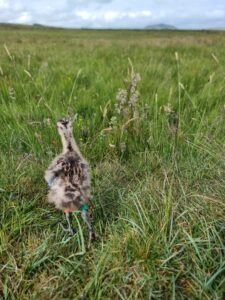
Curlew chick NX © RSPB Katie Gibb
“This brood was about 500 metres or more from where the lost brood had been,” Katie said. “They had developed more slowly this season, like some of the other broods, and they were still on the ground well beyond the five weeks we’d normally see. It was just the adult male with them by this stage, as the female had already left for the coast to get back into condition. Suddenly, I got a good view of the chicks in the long grass, and could see their leg flags – NY and NX, as expected, and then none other than LH, one of the chicks we thought had died! It was so exciting to see.”
If it hadn’t been for the leg flags, we’d have assumed that the final three chicks were all siblings from the same brood. But it proved not only that one had survived but that it had been adopted into another brood.
“Adoption isn’t unheard of among waders, but we haven’t been able to find any other documented cases among Curlews,” Katie said. “Whether or not it’s the first, it adds to the knowledge about this cryptic species for everyone who’s working to help them grow their dwindling populations.”
Katie has high hopes that this year’s ringing will reveal a lot more Curlew secrets in the future.
“It will be fascinating to know how many of our juveniles return to the site, where they set up their territories, and whether they pair up with other ringed birds,” she said. “It should also give us really vital information on how long they survive for.”
Katie’s also hoping that ringing will fill in one vital missing piece of information about the Antrim Plateau Curlews: where they overwinter.
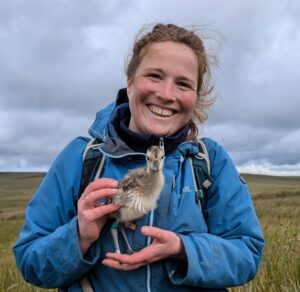
Katie Gibb with Curlew chick NY © RSPB Stephen Magennis
“I’ve got my fingers crossed for sightings of our ringed birds outside the breeding season,” she said. “We don’t know where they go when they leave here – whether they stay around the coast of Ireland somewhere, or migrate even further south into France, Spain or Portugal. It could be really valuable knowledge for their conservation overall.”
As for LH and its new siblings, they did all make it to the skies, fledging together during the first weekend in August 2024. Will the tardy brood make it through their first winter and return to the Antrim Plateau? Time will tell!